 Add to Chrome
 Add to Firefox
 Add to Edge
Lngram: N-gram Conditional Memory in Latent Space
May 24, 2026
Sequence modeling requires both compositional reasoning and local static knowledge retrieval, yet standard Transformers handle both through dense computation. Engram partially decouples retrieval from the backbone, but its token-based keys remain tied to text tokenization and hash compression. We propose Lngram, a latent-space conditional memory module that learns discrete symbols directly from hidden states and performs N-gram lookup over these symbols. This design removes the dependence on tokenizer IDs and naturally extends to non-text modalities. In our evaluated settings, Lngram outperforms Transformer and Engram baselines, consistently reduces perplexity in long-context language modeling, and effectively injects domain knowledge when added post hoc to pretrained models. Joint training with the backbone further surpasses full fine-tuning, while experiments on vision-language and vision-language-action tasks show overall gains. Analyses with LogitLens and CKA suggest that Lngram enables prediction-relevant information to emerge earlier, increasing effective depth with limited inference and memory overhead. Code is available at https://github.com/zyaaa-ux/Lngram.

Plug-and-play Class-aware Knowledge Injection for Prompt Learning with Visual-Language Model
May 07, 2026Prompt learning has become an effective and widely used technique in enhancing vision-language models (VLMs) such as CLIP for various downstream tasks, particularly in zero-shot classification within specific domains. Existing methods typically focus on either learning class-shared prompts for a given domain or generating instance-specific prompts through conditional prompt learning. While these methods have achieved promising performance, they often overlook class-specific knowledge in prompt design, leading to suboptimal outcomes. The underlying reasons are: 1) class-specific prompts offer more fine-grained supervision compared to coarse class-shared prompts, which helps prevent misclassification of data from different classes into a single class; 2) compared to class-specific prompts, instance-specific prompts neglect the richer class-level information across multiple instances, potentially causing data from the same class to be divided into multiple classes. To effectively supplement the class-specific knowledge into existing methods, we propose a plug-and-play Class-Aware Knowledge Injection (CAKI) framework. CAKI comprises two key components, i.e., class-specific prompt generation and query-key prompt matching. The former encodes class-specific knowledge into prompts from few-shot samples that belong to the same class and stores the learned prompts in a class-level knowledge bank. The latter provides a plug-and-play mechanism for each test instance to retrieve relevant class-level knowledge from the knowledge bank and inject such knowledge to refine model predictions. Extensive experiments demonstrate that our CAKI effectively improves the performance of existing methods on base and novel classes. Code is publicly available at \href{https://github.com/yjh576/CAKI}{this https URL}.
Generalizable Dense Reward for Long-Horizon Robotic Tasks
Mar 31, 2026Existing robotic foundation policies are trained primarily via large-scale imitation learning. While such models demonstrate strong capabilities, they often struggle with long-horizon tasks due to distribution shift and error accumulation. While reinforcement learning (RL) can finetune these models, it cannot work well across diverse tasks without manual reward engineering. We propose VLLR, a dense reward framework combining (1) an extrinsic reward from Large Language Models (LLMs) and Vision-Language Models (VLMs) for task progress recognition, and (2) an intrinsic reward based on policy self-certainty. VLLR uses LLMs to decompose tasks into verifiable subtasks and then VLMs to estimate progress to initialize the value function for a brief warm-up phase, avoiding prohibitive inference cost during full training; and self-certainty provides per-step intrinsic guidance throughout PPO finetuning. Ablation studies reveal complementary benefits: VLM-based value initialization primarily improves task completion efficiency, while self-certainty primarily enhances success rates, particularly on out-of-distribution tasks. On the CHORES benchmark covering mobile manipulation and navigation, VLLR achieves up to 56% absolute success rate gains over the pretrained policy, up to 5% gains over state-of-the-art RL finetuning methods on in-distribution tasks, and up to $10\%$ gains on out-of-distribution tasks, all without manual reward engineering. Additional visualizations can be found in https://silongyong.github.io/vllr_project_page/
Self-Refining Vision Language Model for Robotic Failure Detection and Reasoning
Feb 12, 2026Reasoning about failures is crucial for building reliable and trustworthy robotic systems. Prior approaches either treat failure reasoning as a closed-set classification problem or assume access to ample human annotations. Failures in the real world are typically subtle, combinatorial, and difficult to enumerate, whereas rich reasoning labels are expensive to acquire. We address this problem by introducing ARMOR: Adaptive Round-based Multi-task mOdel for Robotic failure detection and reasoning. We formulate detection and reasoning as a multi-task self-refinement process, where the model iteratively predicts detection outcomes and natural language reasoning conditioned on past outputs. During training, ARMOR learns from heterogeneous supervision - large-scale sparse binary labels and small-scale rich reasoning annotations - optimized via a combination of offline and online imitation learning. At inference time, ARMOR generates multiple refinement trajectories and selects the most confident prediction via a self-certainty metric. Experiments across diverse environments show that ARMOR achieves state-of-the-art performance by improving over the previous approaches by up to 30% on failure detection rate and up to 100% in reasoning measured through LLM fuzzy match score, demonstrating robustness to heterogeneous supervision and open-ended reasoning beyond predefined failure modes. We provide dditional visualizations on our website: https://sites.google.com/utexas.edu/armor
Design and Modeling of a Simple-Structured Continuously Variable Transmission Utilizing Shape Memory Alloy Superelasticity for Twisted String Actuator
Dec 23, 2025Twisted String Actuators (TSAs) are widely used in robotics but suffer from a limited range of Transmission Ratio (TR) variation, restricting their efficiency under varying loads.To overcome this, we propose a novel lightweight, simple-structured Continuously Variable Transmission (CVT) mechanism for TSA utilizing Shape Memory Alloy (SMA) superelasticity. The CVT mechanism consists solely of a pair of highly lightweight superelastic SMA rods connecting the ends of twisted strings. These rods deform under external loads, adjusting the inter-string distance to enable continuous TR variation.We develop a comprehensive theoretical model that integrates three critical nonlinearities
Multi-Agent-as-Judge: Aligning LLM-Agent-Based Automated Evaluation with Multi-Dimensional Human Evaluation
Jul 28, 2025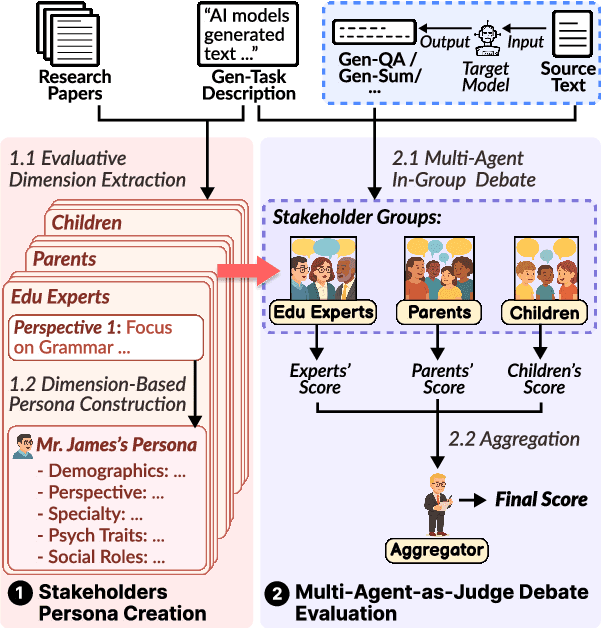
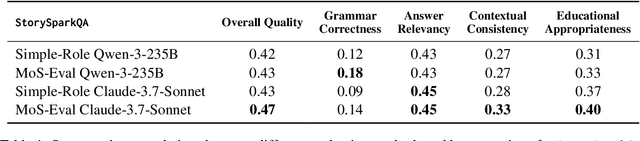
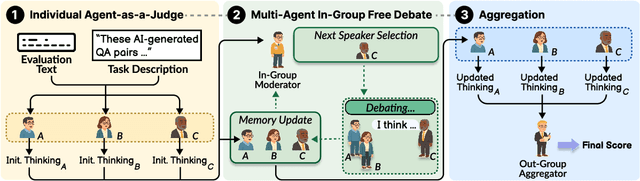
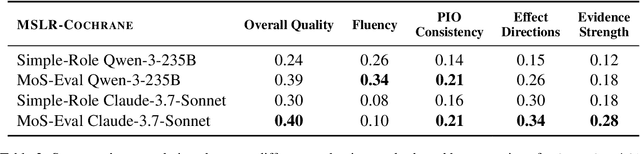
Nearly all human work is collaborative; thus, the evaluation of real-world NLP applications often requires multiple dimensions that align with diverse human perspectives. As real human evaluator resources are often scarce and costly, the emerging "LLM-as-a-judge" paradigm sheds light on a promising approach to leverage LLM agents to believably simulate human evaluators. Yet, to date, existing LLM-as-a-judge approaches face two limitations: persona descriptions of agents are often arbitrarily designed, and the frameworks are not generalizable to other tasks. To address these challenges, we propose MAJ-EVAL, a Multi-Agent-as-Judge evaluation framework that can automatically construct multiple evaluator personas with distinct dimensions from relevant text documents (e.g., research papers), instantiate LLM agents with the personas, and engage in-group debates with multi-agents to Generate multi-dimensional feedback. Our evaluation experiments in both the educational and medical domains demonstrate that MAJ-EVAL can generate evaluation results that better align with human experts' ratings compared with conventional automated evaluation metrics and existing LLM-as-a-judge methods.
SMAR: Soft Modality-Aware Routing Strategy for MoE-based Multimodal Large Language Models Preserving Language Capabilities
Jun 06, 2025Mixture of Experts (MoE) architectures have become a key approach for scaling large language models, with growing interest in extending them to multimodal tasks. Existing methods to build multimodal MoE models either incur high training costs or suffer from degraded language capabilities when adapting pretrained models. To address this, we propose Soft ModalityAware Routing (SMAR), a novel regularization technique that uses Kullback Leibler divergence to control routing probability distributions across modalities, encouraging expert specialization without modifying model architecture or heavily relying on textual data. Experiments on visual instruction tuning show that SMAR preserves language ability at 86.6% retention with only 2.5% pure text, outperforming baselines while maintaining strong multimodal performance. Our approach offers a practical and efficient solution to balance modality differentiation and language capabilities in multimodal MoE models.
Enhancing Complex Instruction Following for Large Language Models with Mixture-of-Contexts Fine-tuning
May 17, 2025Large language models (LLMs) exhibit remarkable capabilities in handling natural language tasks; however, they may struggle to consistently follow complex instructions including those involve multiple constraints. Post-training LLMs using supervised fine-tuning (SFT) is a standard approach to improve their ability to follow instructions. In addressing complex instruction following, existing efforts primarily focus on data-driven methods that synthesize complex instruction-output pairs for SFT. However, insufficient attention allocated to crucial sub-contexts may reduce the effectiveness of SFT. In this work, we propose transforming sequentially structured input instruction into multiple parallel instructions containing subcontexts. To support processing this multi-input, we propose MISO (Multi-Input Single-Output), an extension to currently dominant decoder-only transformer-based LLMs. MISO introduces a mixture-of-contexts paradigm that jointly considers the overall instruction-output alignment and the influence of individual sub-contexts to enhance SFT effectiveness. We apply MISO fine-tuning to complex instructionfollowing datasets and evaluate it with standard LLM inference. Empirical results demonstrate the superiority of MISO as a fine-tuning method for LLMs, both in terms of effectiveness in complex instruction-following scenarios and its potential for training efficiency.
FreeGraftor: Training-Free Cross-Image Feature Grafting for Subject-Driven Text-to-Image Generation
Apr 22, 2025Subject-driven image generation aims to synthesize novel scenes that faithfully preserve subject identity from reference images while adhering to textual guidance, yet existing methods struggle with a critical trade-off between fidelity and efficiency. Tuning-based approaches rely on time-consuming and resource-intensive subject-specific optimization, while zero-shot methods fail to maintain adequate subject consistency. In this work, we propose FreeGraftor, a training-free framework that addresses these limitations through cross-image feature grafting. Specifically, FreeGraftor employs semantic matching and position-constrained attention fusion to transfer visual details from reference subjects to the generated image. Additionally, our framework incorporates a novel noise initialization strategy to preserve geometry priors of reference subjects for robust feature matching. Extensive qualitative and quantitative experiments demonstrate that our method enables precise subject identity transfer while maintaining text-aligned scene synthesis. Without requiring model fine-tuning or additional training, FreeGraftor significantly outperforms existing zero-shot and training-free approaches in both subject fidelity and text alignment. Furthermore, our framework can seamlessly extend to multi-subject generation, making it practical for real-world deployment. Our code is available at https://github.com/Nihukat/FreeGraftor.
Robot Skin with Touch and Bend Sensing using Electrical Impedance Tomography
Mar 17, 2025Flexible electronic skins that simultaneously sense touch and bend are desired in several application areas, such as to cover articulated robot structures. This paper introduces a flexible tactile sensor based on Electrical Impedance Tomography (EIT), capable of simultaneously detecting and measuring contact forces and flexion of the sensor. The sensor integrates a magnetic hydrogel composite and utilizes EIT to reconstruct internal conductivity distributions. Real-time estimation is achieved through the one-step Gauss-Newton method, which dynamically updates reference voltages to accommodate sensor deformation. A convolutional neural network is employed to classify interactions, distinguishing between touch, bending, and idle states using pre-reconstructed images. Experimental results demonstrate an average touch localization error of 5.4 mm (SD 2.2 mm) and average bending angle estimation errors of 1.9$^\circ$ (SD 1.6$^\circ$). The proposed adaptive reference method effectively distinguishes between single- and multi-touch scenarios while compensating for deformation effects. This makes the sensor a promising solution for multimodal sensing in robotics and human-robot collaboration.